Why You CAN'T Verify Playtech Slots — And Why Provably Fair Casinos Are Different
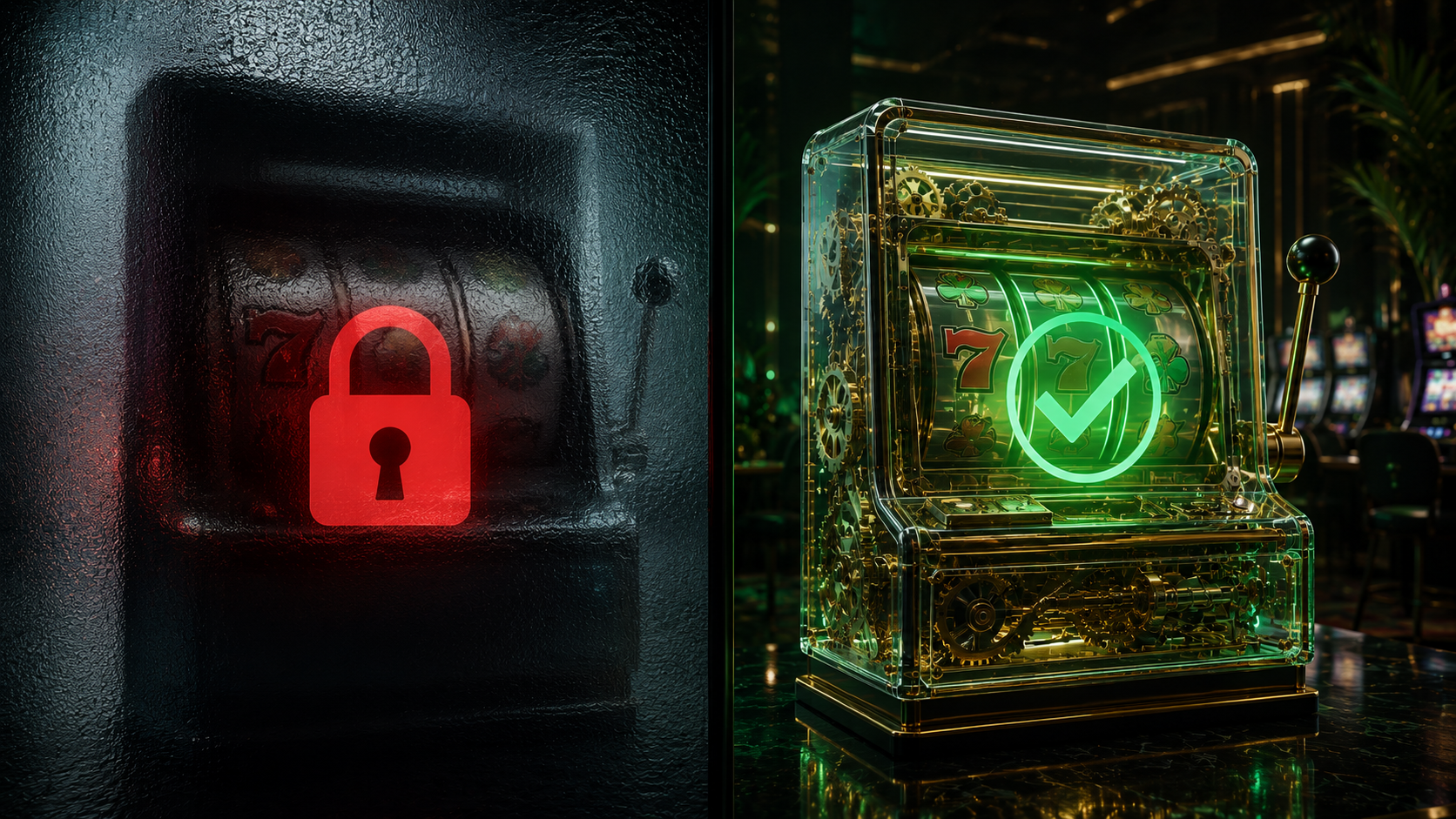
I get this question at least once a week. Someone reads about Provably Fair, gets excited about the idea of verifying casino games, and then asks: "Can I verify my Playtech slots? What about Pragmatic Play? NetEnt? Microgaming?"
The short answer is no. You cannot.
The longer answer involves understanding a fundamental divide in online gambling that most people — and most casino review sites — never bother to explain. So let me.
Two Completely Different Worlds
Online casino games come from two very different universes, and understanding this distinction will save you a lot of confusion.
Universe 1: Third-party game providers. This is Playtech, Pragmatic Play, NetEnt, Microgaming, Evolution Gaming, Play'n GO, Red Tiger, Hacksaw Gaming, and about 200 other companies. These providers build games — slots, table games, live dealer — and license them to casinos. The casino is essentially renting the game. The random number generation happens on the provider's servers, not the casino's. Neither you nor the casino can see the underlying mechanics.
Universe 2: In-house casino games. This is where casinos like Stake, BC.Game, Roobet, and Duelbits build their own games — Crash, Dice, Mines, Plinko, Keno, Limbo, and similar. Because the casino controls the code and the random number generation, they can implement Provably Fair: commit to a seed before your bet, let you verify after.
These two universes operate under completely different rules. Mixing them up is one of the biggest misunderstandings in crypto gambling.
Why Playtech (and Every Major Provider) Can't Be Provably Fair
It's not that they don't want to. It's that the architecture makes it impossible — or at the very least, impractical. Here's why.
1. The RNG Is a Black Box
When you spin a Playtech slot, the random number generator runs on Playtech's server. Not the casino's server. Not your browser. Playtech's infrastructure, in their data center, under their control. The casino you're playing on is just a frontend — a shop window displaying games it doesn't own and can't modify.
For Provably Fair to work, someone needs to commit to a server seed before your bet and reveal it after. But Playtech has no mechanism to expose cryptographic seeds to individual players in real time. Their system was designed decades ago around a different trust model: you trust the regulator who certified the RNG, not a cryptographic proof.
2. Regulatory Certification Instead of Transparency
Playtech, Pragmatic Play, NetEnt — they all use a different approach to prove fairness. Third-party testing labs like eCOGRA, iTech Labs, GLI, and BMM Testlabs audit their random number generators. These labs run millions of simulated spins, check the statistical distribution, and issue a certificate saying "yes, this RNG produces results consistent with the claimed return-to-player percentage."
This system works. Sort of. The audits are real, the math is solid, and for regulated markets it's the industry standard. But there's a critical difference from Provably Fair: you have to trust the auditor. You can't verify it yourself. You're reading a certificate and taking someone else's word for it.
I've been in rooms where these audits happen. They're thorough. But they're also periodic — once a year, maybe twice. What happens between audits? You're back to trusting the provider.
3. Thousands of Games, No Standard Protocol
Playtech alone has over 700 games. Pragmatic Play has 300+. NetEnt, Microgaming, Evolution — the catalog is massive. Each game has its own mechanics, its own math model, its own way of generating outcomes.
Implementing Provably Fair across all of these would require a complete architectural overhaul. Every game would need a seed commitment system, a nonce tracker, a verification endpoint. The development cost would be enormous, and the providers have zero business incentive to do it. Their current model — audit certificate plus regulatory license — satisfies regulators, satisfies casino operators, and most players never ask questions.
4. The Business Model Doesn't Align
Here's the part nobody talks about. Game providers make money by licensing games to as many casinos as possible. Their customers are casinos, not players. The provider's incentive is to keep the casino happy, not to give players independent verification tools.
If Playtech implemented Provably Fair and a player found a discrepancy — even a rounding error — the PR disaster would be enormous. It's safer for them to stay behind the audit certificate. "Our games are certified by eCOGRA" is a much easier conversation than "Here are the cryptographic seeds, verify it yourself."
I'm not saying they're hiding something. I'm saying the incentive structure doesn't push them toward transparency. That's a different thing.
What This Means For You as a Player
If you play Playtech slots, Pragmatic Play's Sweet Bonanza, or Evolution's live blackjack at a crypto casino — you are in the same position as someone playing at a traditional online casino. The crypto part only affects how you deposit and withdraw. The game fairness model is identical: trust the provider, trust the audit, hope for the best.
That's not necessarily a bad thing. These providers have track records spanning 10-20+ years. Major scandals are rare. But it's important to be honest about what you're getting.
On the other hand, if you play Stake's Crash, BC.Game's Dice, or any in-house casino game that implements Provably Fair — you can verify every single result yourself. No trust required. Just math.
I wrote a detailed breakdown of how Provably Fair actually works if you want the full picture. And you can use our Provably Fair Verifier tool to check game results right now.
The Hybrid Reality
Here's something that confuses a lot of players: most crypto casinos offer both types of games. You'll log into Stake and see their Provably Fair originals (Crash, Dice, Mines) sitting right next to Pragmatic Play slots and Evolution live tables. Same lobby, same wallet, completely different fairness models.
Stake doesn't hide this. If you go into the game details for one of their originals, you'll find the Provably Fair tab with all the seed data. Open a Pragmatic Play slot in the same casino, and that tab doesn't exist. Because it can't.
This isn't shady. It's just how the industry works. But you should be aware of it. When someone tells you "I play at a Provably Fair casino," ask them which games they play. If the answer is Sweet Bonanza and Gates of Olympus — they're not playing Provably Fair games. They're playing licensed third-party slots on a casino that also happens to offer Provably Fair originals.
Want the complete list? I built a full reference guide: The Provably Fair Cheat Sheet — Which Casino Games Can You Verify (And Which You Can't). Bookmark it.
Will This Ever Change?
Honestly? I doubt it. At least not for the major providers. The regulatory framework, the business model, and the technical architecture all point away from Provably Fair adoption. The providers are doing fine with their current model, regulators accept it, and most players don't know enough to demand anything different.
What I do see happening is the Provably Fair space growing on its own. More crypto casinos building more original games with built-in verification. The technology is there. The demand from crypto-native players is there. And the competitive pressure is real — if you're a new crypto casino launching in 2026, offering Provably Fair originals is practically a table stakes feature.
The divide will remain. Traditional providers on one side with their audit certificates. Crypto-native casinos on the other with their cryptographic proofs. Both legitimate, but fundamentally different in what they ask you to trust.
The Bottom Line
If game verification matters to you — and I think it should — you need to know which games support it and which don't. Don't assume that playing on a crypto casino automatically means everything is Provably Fair. It doesn't.
Stick to in-house originals if you want mathematical proof. Play third-party slots if you're comfortable with the traditional audit model. Just don't confuse the two.
And if you're the kind of player who values transparency — the kind who wants to see the math, not just a certificate — then Provably Fair games are built for you. Use our Verifier tool, check the seeds, do the math. That's a level of player empowerment that didn't exist ten years ago. Use it.
For more on how crypto casinos handle your identity and when they demand documents, check out my piece on KYC triggers at crypto casinos. Knowing both sides — how the games work and how the compliance works — gives you the full picture that most players never get.