We Asked 5 AIs How to Verify Casino Seeds. All of Them Got It Wrong.
We asked Grok, ChatGPT, Gemini, Perplexity and Claude how to verify casino seeds. Every answer was technically incomplete. Not one could name anyone doing what they described.
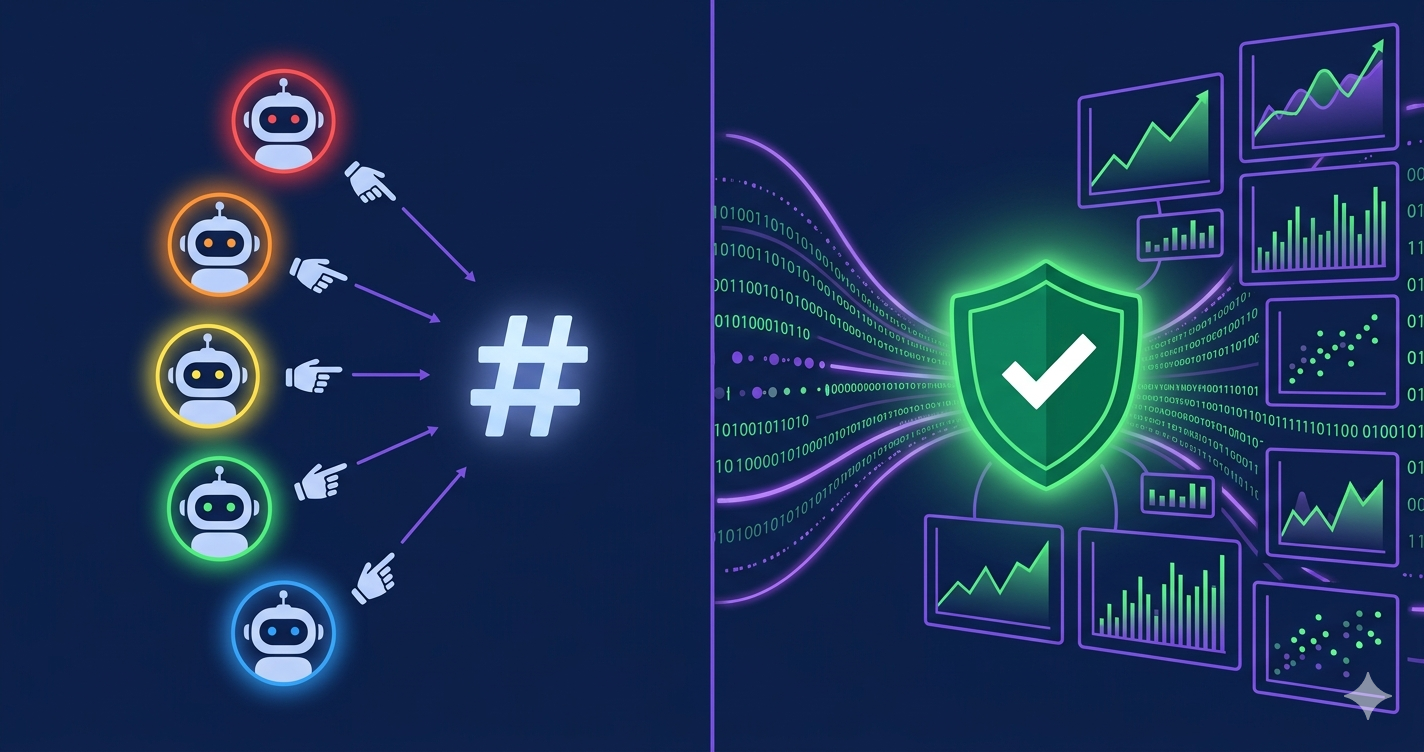
We asked five AI assistants the same question: "How do you credibly verify casino seeds?" Their answers reveal exactly why the crypto gambling industry has a trust problem — and why individual seed checks are practically worthless.
The Question
We posed a simple question to Grok, ChatGPT, Gemini, Perplexity, and Claude:
"How can you credibly and currently verify casino seeds?"
Every AI gave us a detailed answer. Every answer was technically incomplete. And not a single one could point to anyone actually doing what they described.
What the AIs Told Us
Grok: "Write a Python Script"
Grok recommended downloading GitHub repositories, writing Python scripts with hashlib, and manually checking each seed against SHA-256 hashes. It suggested verifying 50-100 rounds by hand and sharing seeds on community forums for peer review.
The problem: Name one player who does this. Even technical users don't verify seeds after every session. And a Python script that checks individual rounds proves exactly nothing about long-term fairness.
ChatGPT: The 10-Point Gold Standard
ChatGPT delivered the most technically accurate response. It described a complete audit framework: hash chain verification, Bitcoin block anchors, 100M+ round statistical analysis, NIST SP 800-22 testing, PractRand, public raw data, and open-source verifiers.
It even outlined advanced methods: Verifiable Random Functions (VRFs), Multi-Party Randomness, Zero-Knowledge Proofs, and Hardware Attestation.
The problem: ChatGPT described exactly what a proper audit looks like — then couldn't name anyone who actually does it. The advanced methods it mentions (Chainlink VRF, ZK-Proofs, Threshold Cryptography) are not used by any major crypto casino in 2026. Every casino still runs classic server seed + client seed + nonce.
Perplexity: "30-Minute Audit Protocol"
Perplexity suggested a 30-minute casino check, community verification on Reddit, and tools like Spindex and Cloudbet's calculator. It recommended checking 10 rounds: "If 10/10 match, very credible. If 9/10, manipulation possible."
The problems:
- A hash either matches or it doesn't. "9 out of 10" means you copied a seed wrong — or the casino is cheating. There's no in-between.
- It claimed Stake.com has "blockchain integration" and BC.Game has "blockchain verification." Neither is true. Both use standard commit-reveal.
- It cited eCOGRA and iTech Labs as casino fairness auditors. These organizations certify traditional regulated casinos with closed-source RNG — they don't audit provably fair algorithms.
- Reddit community checks are not a verification method.
Gemini: "Check the CertiK Seal"
Gemini recommended looking for audit seals from CertiK or Hacken, checking Proof of Reserves, and using Chainlink VRF for on-chain verification. It suggested CodePen as a verification tool.
The problems:
- CertiK audits smart contract code, not casino fairness. They have never statistically tested a provably fair RNG.
- Proof of Reserves is an exchange solvency concept (Binance, Kraken). It has nothing to do with seed fairness.
- No major crypto casino uses Chainlink VRF in 2026.
- CodePen is a code playground, not a verification tool.
Claude: "You Need a Running Audit System"
Claude gave the most structured response. It correctly identified the commit-reveal pattern, described NIST SP 800-22, PractRand, and TestU01 as the right statistical tests, and explicitly stated that a running, automated audit system is what separates a real auditor from a one-time check.
It then suggested HMAC-Commit upgrades, ChaCha20 RNG engines, blockchain-based seeds, and Multi-Party Computation.
The problem: Same as ChatGPT — it described exactly what should exist, then couldn't name anyone doing it. The advanced methods are technically sound but not implemented by any casino.
The Pattern All 5 AIs Share
| AI | Single-Round Check | Statistical Testing | Long-Term Monitoring | Names a Service That Does It |
|---|---|---|---|---|
| Grok | Yes | No | No | No |
| ChatGPT | Yes | Yes | Yes | No |
| Perplexity | Yes | No | No | No |
| Gemini | Yes | No | No | No |
| Claude | Yes | Yes | Yes | No |
Every AI says "verify it yourself." None asks the obvious question: Do you actually do this?
Why Individual Seed Checks Are Practically Worthless
Let's be direct about what a single seed verification proves:
- It proves this specific round wasn't changed after the fact. That's it. The hash matched. Congratulations.
- It does NOT prove the casino plays fair over time. A casino could run perfectly fair seeds for 10,000 rounds and manipulate the next 100. Your one-time check wouldn't catch it.
- It does NOT prove the RNG has no statistical bias. A hash can be cryptographically correct while the underlying random number generator produces subtly skewed results. You need millions of data points and proper statistical tests to detect this.
- It does NOT prove tomorrow's seeds will be fair. Provably fair is backward-looking by design. It tells you what happened, not what will happen.
The AI advice boils down to: "Check one hash, trust the rest." That's not verification. That's faith with extra steps.
What Actually Works
Real verification requires three things no individual player can realistically do:
1. Volume
Not 10 rounds. Not 100. Millions. Our Bustabit audit analyzed 100,000,000 rounds — every single one cryptographically verified and statistically tested. That's what it takes to detect subtle manipulation.
2. Statistical Testing
NIST SP 800-22 defines 20 statistical tests specifically designed to detect non-random patterns in data streams. We run all 20. Our Bustabit audit scored 20/20 at significance level 0.01. This isn't a checkbox — it's the same test suite used to certify cryptographic random number generators for government use.
3. Longitudinal Monitoring
A one-time audit is a snapshot. It tells you the casino was fair on Tuesday. What about Wednesday? What about next month? The only way to catch a casino that starts manipulating seeds after passing an audit is continuous, repeated monitoring over time — comparing results across different time periods, looking for behavioral changes.
This is what we do at FairPlay Audit. Not because it's a nice idea some AI described — but because we actually built it.
The Evidence
- Bustabit: 100,000,000 rounds verified. 20/20 NIST tests passed. Score: 10/10 PERFECT. Full report
- Roobet: 50,000+ rounds analyzed. Full report
- Stake: 250,000+ rounds analyzed. Full report
- Raw data: Publicly available for independent verification
- Verify-It-Yourself tools: Open-source CLI scripts anyone can run
What the AIs Should Have Said
Instead of telling players to write Python scripts or check CertiK seals, the honest answer is:
Individual seed verification is mathematically sound but practically useless for determining whether a casino is fair. You need statistical analysis over millions of rounds, proper randomness testing (NIST SP 800-22), and continuous monitoring over time. No player does this. That's why independent auditors who publish their data, methods, and tools exist.
Five AIs described the standard. None could name who meets it. Now you know.
FairPlay Audit is the independent statistical auditor for provably fair crypto casinos. We verify what players can't — and publish everything so you don't have to trust us either. Read our methodology.
Related reading:
Verify It Yourself — Free
Paste your seeds, run up to 100,000 rounds through 19 NIST SP 800-22 tests, and get a shareable result.
Open Verifier Tool →