How Crypto Casino Streamers Fake Their Wins - And How to Check Their Seeds
Sponsored accounts, play money, manipulated odds. The streaming industry has a fraud problem. Here's how to verify if a streamer's wins are real - using the same tools casinos use.
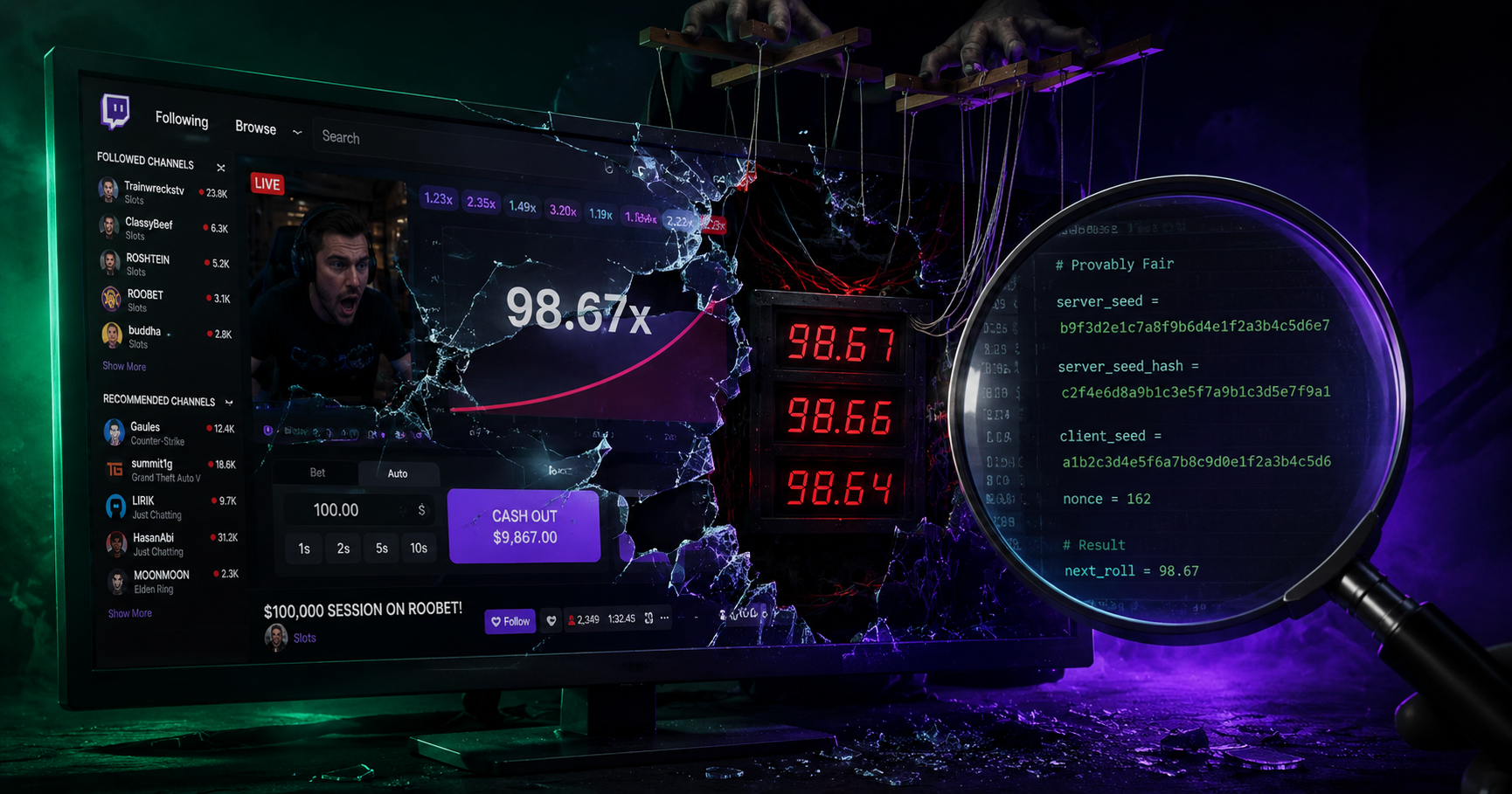
I've watched thousands of hours of casino content in my career. First from behind the table, now from behind a screen. And I can tell you this: a significant portion of what you see on Twitch, Kick, and YouTube gambling streams is not what it appears to be.
This isn't speculation. I'm going to show you exactly how streamer fraud works, what the documented cases look like, and - most importantly - how you can verify any streamer's bets yourself using provably fair data.
The Three Ways Streamers Fake It
1. Sponsored "Play Money" Accounts
This is the most common and least discussed problem. Casinos load streamer accounts with non-withdrawable funds - sometimes $100,000 or more. The streamer plays with this money on camera, creates exciting content with huge bets, and earns revenue through affiliate sign-ups from viewers who think they're watching real gambling.
The streamers are technically playing. The games are technically fair. But the risk is zero. When Adin Ross bets $50,000 on a single crash round, his actual financial exposure might be nothing. The excitement you feel watching is manufactured.
Names that have faced scrutiny: Adin Ross, Xposed, ClassyBeef, AyeZee, and Yassuo. Not all are confirmed frauds - but the transparency around their funding is consistently absent.
2. Manipulated Odds on Owned Platforms
Some streamers don't just promote casinos - they own them. Or they have equity stakes that give them access to the backend. In these cases, the odds can be literally adjusted for their account.
ZKasino claimed to use blockchain technology for fairness. It raised $30 million from users. Then it blocked withdrawals and was exposed as outright fraud. The "provably fair" label was pure marketing - there was no actual cryptographic verification available to players.
This is why the method of verification matters more than the claim of fairness. If you can't independently verify the seeds, hashes, and outcomes, the word "provably fair" is meaningless.
3. Selective Highlight Reels
This one is subtle. A streamer plays for 8 hours, loses $40,000, then hits one massive win of $60,000. The YouTube video shows only the win. The Telegram group posts only the screenshot. The clip goes viral.
Mathematically, the streamer lost money during that session - the house edge guarantees it over time. But the content only shows the peak.
How to Verify a Streamer's Bets
Here's what no other article tells you: if a streamer plays at a provably fair casino, you can verify every single bet they make. Here's how.
Step 1: Get Their Seed Data
Legitimate streamers who have nothing to hide will share:
- Their client seed (visible during play)
- Their server seed hash (visible before rotation)
- The nonce for each bet
If a streamer refuses to share this data, that's your first red flag. The entire point of provably fair is that the data is shareable and verifiable.
Step 2: Run the Verification
Take their seed data and put it into our Verifier Tool. The tool recalculates the outcome using HMAC-SHA256. If the result matches what appeared on screen, the bet was legitimate. If it doesn't, something was manipulated.
Step 3: Check the Distribution
One verified bet proves one bet. To check if a streamer is getting abnormal results, you need a larger sample. This is exactly what our audit methodology does - we run NIST SP 800-22 statistical tests across thousands of outcomes to detect bias.
Our Stake audit tested 250,000 rounds. If a streamer's results deviate significantly from what those tests predict, either they're extraordinarily lucky, or something is wrong with their account.
The $81.4 Billion Problem
According to CasinoAlpha, illegal and scam-related software in the crypto casino space collected $81.4 billion in 2025. AI-powered impersonation scams targeting crypto casino players grew 1,400% year-over-year.
This isn't a fringe problem. It's an industry-wide crisis. And the streaming ecosystem is at the center of it because that's where the trust is built - and exploited.
What You Should Demand from Streamers
- Publish your seeds. If you're playing provably fair games, there's zero reason to hide seed data after rotation.
- Disclose your funding. Are you playing with your own money, casino money, or sponsored funds? Players deserve to know.
- Show the full session. Not just the highlights. The losses matter as much as the wins for an honest picture.
- Link to independent verification. Don't just say "provably fair" - point viewers to a tool where they can check it themselves.
Protect Yourself
Check Before You Deposit
See which crypto casinos passed independent statistical audits - and which ones refused to be tested. Data, not promises.
View the FairPlay Audit Tracker → Learn to Verify Yourself →Fake streamer wins are just one side of the scam ecosystem. Another growing threat: Aviator predictor apps that claim to forecast crash game results. We have proven cryptographically why prediction is impossible - yet these scams keep finding victims.
Verify, Don't Trust
The entire point of provably fair technology is that you don't need to trust anyone - not the casino, not the streamer, not us. You can check the math yourself.
Start with our Provably Fair Explained guide if you're new to this. Already know how it works? Open the Verifier Tool and test any bet right now.
Playing on mobile? Read our Mobile Seed Guide to make sure you're saving your proof correctly.
Not sure which games can even be verified? Check the Provably Fair Cheat Sheet.
Casinos that benefit from unverified streamer hype have good reasons to avoid independent testing. Here are the seven excuses they use when asked why.
More from FairPlay Audit
- Telegram Casino Scams: What I've Seen Will Make You Delete Your Bots
- Our Independence and Affiliate Disclosure
- BC.Game Audit: 50,000 Rounds Tested